Yohanna Bedelu turns data into better health outcomes
Published on February 25, 2026
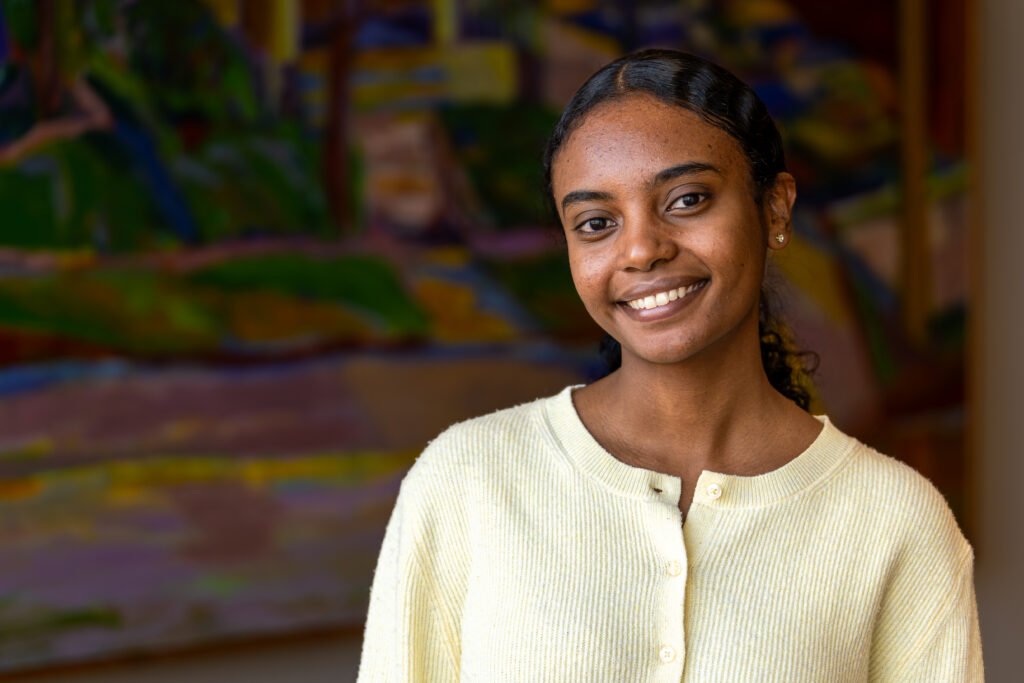
Yohanna Bedelu is a biostatistics graduate student who enjoys tackling complex clinical and public health questions through data. In this Q&A, she reflects on her interdisciplinary academic path, her hands-on research experiences, and where she hopes her training will take her next.
Where is your hometown?
I am originally from Addis Ababa, Ethiopia.
What is your degree/program of study?
I am pursuing a Master of Public Health in Biostatistics through the University of Iowa’s U2G program. I also recently completed my undergraduate degree at Grinnell College, where I majored in Biology with a concentration in Statistics.
You took a non-traditional path to the University of Iowa. Tell us about your background prior to arriving on campus.
My academic path has been intentionally interdisciplinary, and research focused. At Grinnell College, I combined coursework in biology and statistics with firsthand research experience, including applied statistical modeling projects and public health-oriented data analysis. I also worked across institutions such as Penn State University and the Cleveland Clinic which gave me early exposure to collaborative, real world research environments before transitioning into graduate level public health training.
Why did you choose to study biostatistics? What about it interests you?
I enjoy the challenge of using statistical methods to answer complex clinical and public health questions, especially when the results can directly inform research and patient care. Biostatistics allows me to combine technical problem solving with meaningful real-world impact.
What are your research interests?
My research interests include clinical and oncology related outcomes research, survival analysis, and health disparities. I’m particularly interested in how statistical methods can be used to evaluate treatment effectiveness, understand inequities in health outcomes, and translate complex data into insights that clinicians and researchers can act on.
Last summer you interned at the Cleveland Clinic in the oncology department. What did you do there and what did you learn?
At the Cleveland Clinic, I worked as a biostatistics intern in the oncology department, where I analyzed large, multi-site patient datasets using survival analysis methods such as Cox proportional hazards models and Kaplan–Meier estimation. I contributed to studies evaluating treatment outcomes in lymphoma and leukemia patients and co-authored peer-reviewed and conference publications. The experience taught me how rigorous statistical work directly supports clinical research and reinforced the importance of clear data visualization and collaboration with clinicians.
What are your career plans post-MPH?
My long-term goal is to contribute meaningfully to research and work that improves patient outcomes, as well as advance evidence-based decision-making in medicine, innovative biotechnology, and public health.
What have you enjoyed most about your time at the College of Public Health?
What I’ve enjoyed most is the collaborative environment and the emphasis on applying biostatistical theory to real world problems. The program has allowed me to deepen my technical skills while working alongside faculty and peers that are not only supportive but also genuinely committed to improving health outcomes through research and data.