From Iowa to Disneyland: How CPH alumna Emma Smaellie keeps the magic safe
Published on March 2, 2026
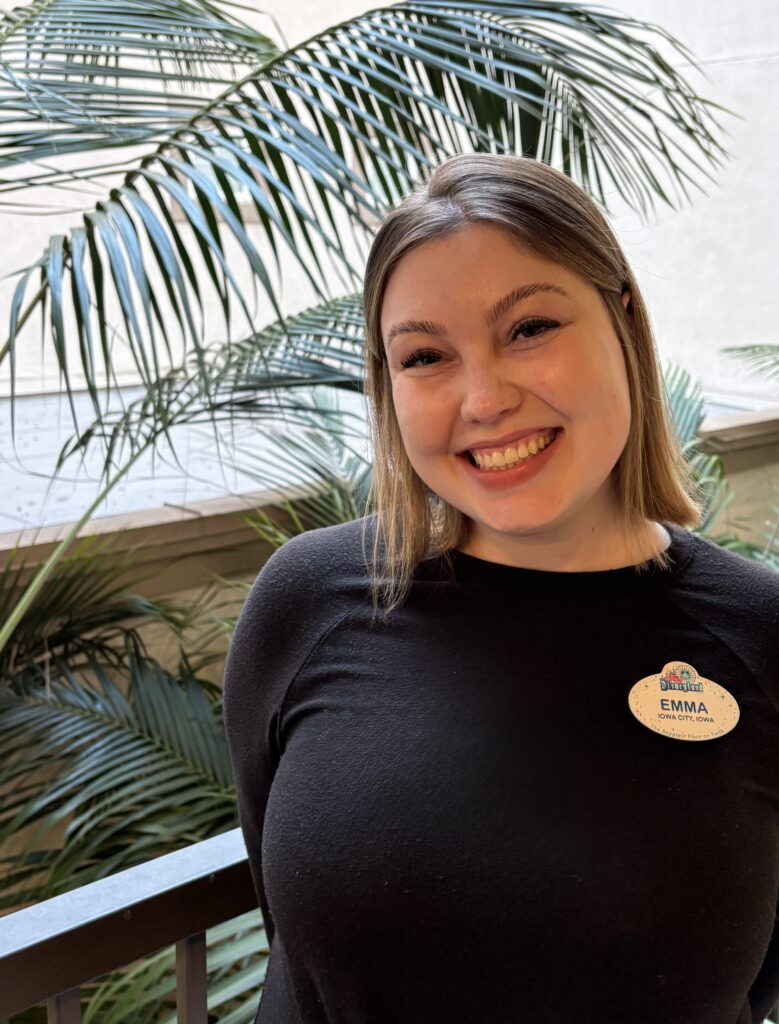
University of Iowa College of Public Health alumna Emma Smaellie (23MS, OEH/Industrial Hygiene) plays a behind‑the‑scenes role in one of the most iconic destinations in the world: the Disneyland Resort. As a safety professional supporting thousands of Disney employees, also known as cast members, across parks, hotels, entertainment spaces, and specialized crafts, Emma uses her industrial hygiene training to ensure the magic happens safely every day. She shares how she found her path, what her work looks like, and why creating a safer workplace is her favorite part of the job.
Disclaimer: These statements are my own and do not reflect my employer’s opinions.
Current City, State
Anaheim, California
What is your current job title and employer?
I am a Safety Professional at Disneyland Resort!
Tell us about the type of work you do, or what a typical day is like.
The Disneyland Resort consists of:
- 2 theme parks (Disneyland Park and Disney California Adventure)
- An outdoor shopping mall with restaurants and entertainment (Downtown Disney District)
- 3 resort hotels (the Disneyland Hotel, the Grand Californian Hotel, and the Pixar Place Hotel).
The primary function of my role is to provide safety support to different business sectors of the resort. Each sector has different needs and challenges, and with 30,000 to 40,000 cast members (Disney employees), you can imagine the wide variety of safety hazards at any given time. This also means no two days are ever the same. I could be in a kitchen walking with our food safety team, at an attraction determining safe access for building repairs, or on a construction site.
I am currently the primary safety contact for a few of our manufacturing and maintenance departments. These teams are made of different crafts such as welders, machinists, painters, plasterers, carpenters, park decorators, seamsters/seamstresses, upholsterers, and so many more. Some of my job responsibilities include conducting safety walks and hazard assessments, assisting with injury and incident investigations, and reviewing contractor safety submittals. I am also taking the lead on more industrial hygiene (IH) projects, approving chemical requests and conducting noise dosimetry and air monitoring assessments.
What do you find most rewarding about your public health work?
While some workdays can be long, stressful, and frustrating, knowing I am working to create an environment where cast members can perform their job functions safely and go home to their families is extremely rewarding. The relationships I build with the business sectors I support is a key part of that satisfaction. Ensuring I learn about the work tasks from cast members and their managers helps me be more effective in my role. Having their input and perspective is crucial to understanding the hazards they face, finding a solution and improving the culture surrounding safety.
What made you choose a career in occupational safety?
As an undergraduate public health major at BYU, I had the opportunity to take introductory classes in occupational safety and industrial hygiene. I found these fields extremely interesting and unique, and was inspired by the work experience of my professors. This field opened a way for me to combine other aspects of public health work into one. While occupational safety/industrial hygiene are unique skill sets, an effective professional still requires basic understanding of and skills in health education and promotion, health policy and implementation, and data analysis.
What steps led to your current role?
One of the most important steps I took to get to where I am today was choosing an internship after graduation. When I was offered the safety professional internship with Disney, I had some anxiety around accepting. I was nervous about how others would react to me having an internship even with a graduate degree, if I should wait for an entry level job, how it would affect future opportunities.
After much consideration, I felt this internship would provide a unique experience and so I accepted! (Who could say no to working with Mickey Mouse?) I was hired into a salaried role after the 6-month internship, and here I am almost 3 years later.
I realized there was absolutely nothing wrong with taking an internship after graduation. At the end of the day, it was an opportunity to gain experience and learn and network as a new grad. It was important for me to realize the title of my job didn’t matter as long as it was adding value to my growth in my career field.
What attributes of your MS Industrial Hygiene degree program prepared you for success in your career?
The MS IH program at Iowa gave me the chance to learn from professors with a combination of field/industry experience and research credentials. By learning from our professors’ real experiences, situations they did/didn’t handle and/or navigated successfully/poorly, and lessons learned, we could trust they knew what it was like to work in the industry and apply classroom theory to the real world. We practiced with real equipment, analyzed case studies, and put our understanding to the test with practical and project-based exams. This aspect of the program left us with strong technical and communication skills, which really prepared me for the workforce after graduation.
What is your favorite memory of your time at Iowa?
One of my favorite memories at Iowa was when the OEH department student association (originally I3HSA, now OEHSAI) hosted a Halloween party at one of our professor’s homes. (Shout out and big thank you to Dr. Tom Peters!) We had a costume contest and a potluck; it was the real deal. I remember it being a really enjoyable time with not only my IH cohort but with the other graduate students in the department! Even some of the OEH professors came for the Halloween fun!