Epi Alumni Discuss Career Paths
Published on May 1, 2026
On April 13, the department welcomed five alumni back for a lively panel discussion on career paths in epidemiology and public health. The nearly hour-long conversation, moderated by MS candidate Lauren Johnson, offered current students an inside look at how a degree from Iowa can open doors across a wide range of professional settings.A full recording of the panel is available here.
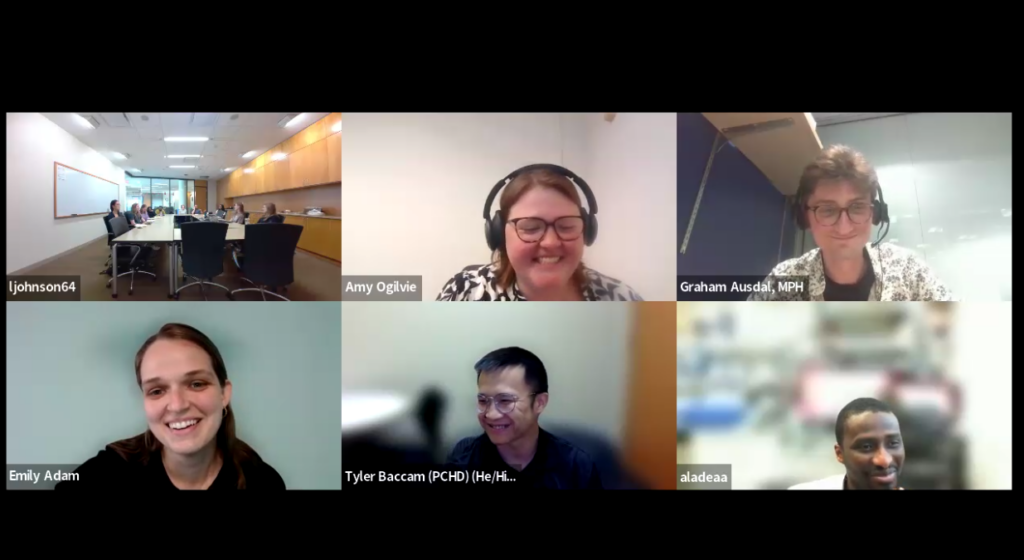
The Panelists
Amy Ogilvie (MS ’20, PhD ’23) is an Assistant Professor in the Division of Health Services Research within the Department of Neurology at The Ohio State University, where she studies health care utilization, caregiver outcomes, and end-of-life care for people with Huntington’s disease. She joined Ohio State in August 2024 following a T32 postdoctoral fellowship at the University of Colorado.
Tyler Baccam (BS ’21, MS ’22) is an Epidemiology Program Manager at the Pima County Health Department in Tucson, Arizona, leading the Data Modernization and Surveillance Team. Part of Iowa’s inaugural undergraduate public health cohort, he credited the data skills he built at Iowa — particularly in R and SAS — as central to his career.
Graham Ausdal (MPH ’23) is a Microbiologist at National Resilience, a pharmaceutical manufacturing company, doing quality control, environmental monitoring, and data-driven troubleshooting. He arrived there by an unexpected route, spending two and a half years after graduation in radiopharmaceutical manufacturing.
Emily Adam (MS ’18) is an Epidemiologist at the CDC’s Division of Cancer Prevention and Control and a Rural Health Fellow with UC Berkeley. She arrived at CDC through a fellowship and, seven years later, is still there.
Azeez Alade (MS ’20, PhD ’23) is a Clinical Fellow at NIH’s National Institute of Dental and Craniofacial Research in Bethesda. A trained dentist, he came to Iowa to study the genetics of orofacial clefts and now combines clinical work with whole-genome sequencing and data analysis — the blend he set out to find.
Did Anyone Plan to End Up Where They Are?
Not really, was the collective answer. Graham sent out 282 job applications after graduation, got two interviews, and accepted the one offer he received — in an industry he hadn’t anticipated. “As long as you keep an open mind and keep track of what you like and what you don’t,” he said, “you’ll be able to find your footing pretty much anywhere with an MPH degree.” Tyler searched nationally, leaned into his data skills, and landed a surveillance role in Arizona. Amy switched tracks mid-program when research pulled her in, ultimately choosing academia because of the control it offered over her own questions. Emily followed a fellowship into CDC and never left, noting a perk of government work that’s easy to overlook: “When I first started in 2019, I didn’t even have access to my email after hours. I would just leave my computer at work. And that was great.”
The Job Market, Honestly
The panelists were frank. Tyler described 2025 as a difficult year for local public health, with COVID-era federal funding expiring and layoffs hitting health departments — including his own. “To be quite frank, 2025 was a big dry period,” he said, while noting that some grants are being restored and cautious optimism is returning. Emily reported that CDC has been under a hiring freeze and the ORISE fellows program, the traditional entry point for new graduates, has faced uncertainty and instability. Azeez observed similar strain at NIH and in academia, but pointed to networking as what ultimately worked for him: he found his current position through a conversation at a conference, not a job board. “You need to come out and reach out to people,” he said. Amy added that postdoctoral positions, after a rocky stretch, are beginning to resurface.
Standing Out
Several clear themes emerged on what makes a candidate memorable. Tailoring applications to match the specific skills an employer lists matters — Emily noted that familiarity with relevant public data sources catches her eye, and Tyler built his entire application around the analytical tools the job had asked for by name. But the panelists also pushed back on the idea that credentials alone carry the day. Graham’s manager introduced him to his new team not by his CV, but by mentioning he does improv comedy. “Ultimately, what people want to see is what you, as a human being, can bring to the team,” he said. Amy made a similar point about soft skills — active listening, genuine conversation, a thank-you email after an interview — adding up to the impression that clinches an offer. And nearly everyone mentioned cold emails: “There are a lot of people out there who are really nice and engaging,” Amy said, “if you show interest in what they’re doing.”
One Piece of Advice
The panel closed with each alumnus offering a single line for current students.
- Amy: Embrace peer mentorship — your classmates are your future colleagues.
- Tyler: Use this time to find your niche; figure out what you love and own it.
- Azeez: Identify the gaps between where you are and the job you want, and fill them now while you still can.
- Graham: Breathe. Drink water. Go outside. You’re still a human being, and things will go well.
- Emily: Don’t be afraid to reach out beyond the department — the cold email works, interdisciplinary coursework pays off, and Iowa people are generally pretty warm.